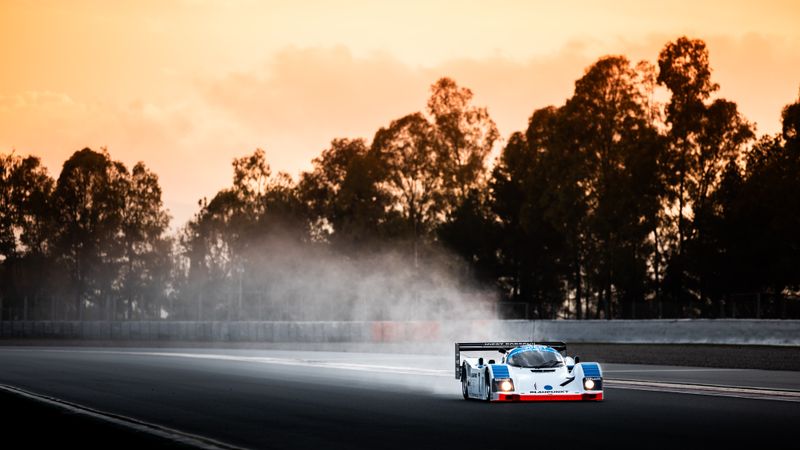
A racing car's aerodynamic setup is a compromise rather than an optimisation. The same devices that generate cornering grip also slow the car in a straight line, and no configuration escapes that relationship.
Downforce is lift working downward
Wings on a racing car are shaped to produce force towards the ground rather than away from it. The principle is identical to an aircraft wing with the profile inverted.
That downward force presses the tyres into the track, increasing the friction available before they slide. Cornering speed rises accordingly.
Because the force grows with the square of speed, the effect is dramatic at high velocity and negligible when slow. A car has far more grip in a fast corner than a slow one.
Drag is the unavoidable cost
Any surface generating downforce also disturbs airflow, creating resistance to forward motion. That drag rises with speed in the same way the downforce does.
Straight-line speed therefore falls as downforce increases. A car set up for maximum cornering grip is measurably slower at the end of a long straight.
Engineers describe this as a ratio, seeking configurations that produce the most downforce for a given amount of drag. Efficiency matters more than raw magnitude.
Circuit character determines the balance
A track dominated by long straights rewards low drag, since time gained in a straight line exceeds time lost through corners. Teams reduce wing angle accordingly.
A twisting circuit inverts that calculation, and cars run maximum downforce because almost all lap time is spent cornering. Setups differ visibly between events.
Most circuits contain both elements, so engineers seek the configuration minimising total lap time rather than optimising either section. Simulation guides the choice before the car runs.
Underbody airflow changed the equation
Shaping the floor to accelerate air beneath the car creates suction that generates downforce with far less drag than wings. It is a more efficient source of the same force.
Regulations govern floor design closely because the effect is powerful and sensitive to ride height. Small changes in how the car sits produce large changes in grip.
Cars relying on underbody downforce are consequently run very close to the ground, which introduces its own difficulties over bumps and kerbs.
Balance matters more than total
Downforce must be distributed between the front and rear axles in proportion to the car's handling requirements. Too much at the front produces instability under braking.
Drivers describe the resulting behaviour as understeer or oversteer, and adjustments to wing angle shift the balance between them. The car is tuned to the driver's preference.
Because the distribution changes with speed, fuel load and tyre wear, the balance a driver feels shifts throughout a race. Managing that shift is a substantial part of the skill.