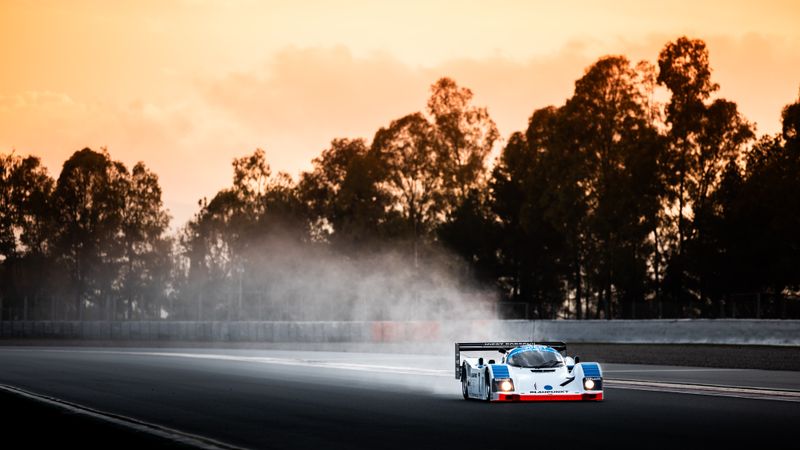
A racing car is measurably faster at the end of a stint than at its beginning, even on worn tyres. The cause is the fuel it has consumed, which changes the car's behaviour continuously.
Mass is the primary effect
Fuel for a full race distance represents a considerable proportion of a car's minimum weight. That mass must be accelerated, braked and turned along with everything else.
Additional weight slows acceleration, extends braking distances and reduces cornering speed. The lap time penalty per unit of fuel is consistent enough that teams calculate it precisely.
As fuel burns, the car becomes progressively lighter and faster. Lap times fall steadily even as tyres degrade, and the two effects partly cancel.
Weight distribution shifts as the tank empties
Fuel is stored in a tank positioned to keep the car balanced, but its mass sits at a particular point. Removing it changes the distribution between front and rear.
Drivers therefore experience a car whose handling balance moves through a stint. A car understeering when full may become neutral or loose when light.
Engineers set the car up for a compromise across the stint rather than for any single moment. Adjustable controls allow the driver to correct balance from the cockpit.
Tyre loading changes with the mass
Heavier cars press harder on their tyres, generating more heat and accelerating degradation. The opening laps of a stint are therefore the hardest on rubber.
This interacts with strategy, because a long first stint on a heavy car costs more tyre life than the same stint later. Teams weigh that when choosing stop timing.
Drivers manage the opening laps deliberately, avoiding sliding while the car is heaviest. Conserving rubber early extends the usable stint considerably.
Fuel management during the race
Where regulations limit total fuel, drivers must complete the distance within an allowance. Consumption depends heavily on throttle use and on how much lifting is done before braking.
Teams monitor consumption continuously against a target and instruct drivers to adjust. Saving fuel costs lap time immediately but prevents a far larger loss later.
Deployment of stored electrical energy is coordinated with this, since it substitutes for fuel in particular sections. The management is a combined calculation rather than a simple one.
Why qualifying pace differs so much
Qualifying is run with minimal fuel, producing the car at its lightest and fastest. Race pace is necessarily slower because the car begins heavy.
Comparing the two directly is therefore misleading, and teams model expected race pace separately. A car strong in qualifying may handle poorly when loaded.
Setup choices reflect that division, since a team must decide how much to optimise for a single fast lap against a long race. The compromise is made before the weekend begins.