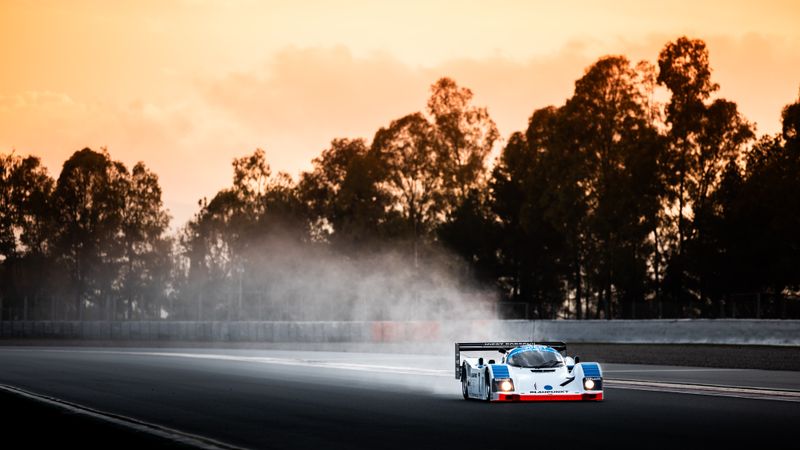
Positions in top-level circuit racing change more often through pit strategy than through wheel-to-wheel passing. The reason lies in what a car loses when it follows another closely.
Following costs more than it appears
A car generates downforce by managing airflow over and under its bodywork. A car ahead disturbs that airflow, so the following car produces less grip through corners.
Reduced grip means slower cornering and greater tyre stress, which compounds over successive laps. The following driver arrives at the straight already disadvantaged.
Overtaking therefore requires a substantial pace advantage rather than a marginal one. Two evenly matched cars can circulate for a long period without the order changing.
Clean air is the strategic prize
A car in free air runs at its natural pace, unhindered by turbulence. Strategy is largely the pursuit of laps in that condition.
Stopping earlier than a rival places a car on fresh tyres in traffic-free space, where it can set faster laps. Those laps accumulate into track position.
The rival must then respond, and the sequence of responses is what strategists plan in advance. The decision is made before the stop rather than during it.
Tyre age creates a temporary performance gap
A fresh set of tyres offers noticeably more grip than one that has completed many laps. The gap is largest immediately after fitting and narrows as the new set warms and wears.
That window is the strategic opportunity. A driver on new tyres must convert the advantage into time before it disappears.
Because degradation rates vary with compound, fuel load and track temperature, teams model them continuously through a race. The model determines when the window opens.
The undercut and its counter
Stopping before a rival and using fresh tyres to gain time is the standard approach, since the rival remains on worn rubber for another lap or two.
The counter is to stay out longer, running in clear air after the rival has stopped, then emerging on much fresher tyres later in the stint. It works when degradation is low.
Which approach succeeds depends on how quickly tyres lose performance at that circuit. Teams choose based on data gathered in practice sessions.
Why the stop itself is only part of it
Pit crews complete a stop in a few seconds, and the difference between a good and a poor stop is a fraction of that. It matters, but less than the timing decision.
The pit lane has a speed limit and a fixed length, so the total time lost is largely fixed. Circuits differ substantially in that cost, which changes optimal strategy.
Strategists therefore weigh the fixed loss against expected gains before committing. The race is often decided by an instruction given several laps earlier.