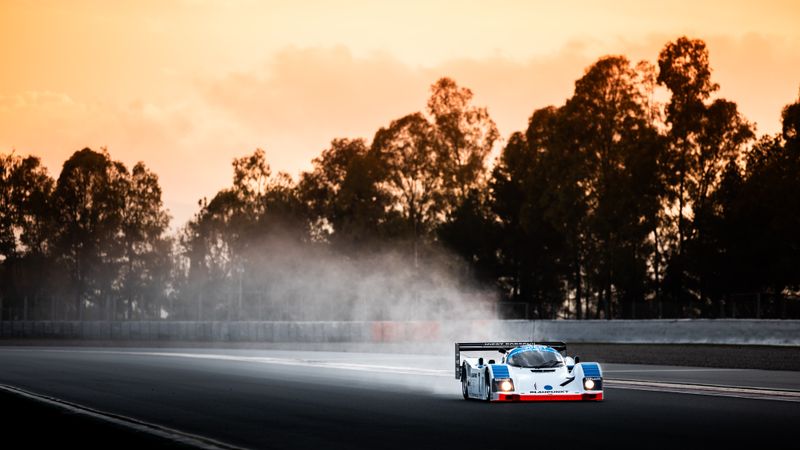
Tyre selection is among the few decisions in circuit racing made before a car turns a wheel and felt through every lap afterwards. The compound choice constrains everything that follows.
Grip and durability move in opposite directions
Softer rubber deforms more readily and conforms to the track surface, generating higher friction. That produces faster lap times immediately.
The same softness means material is removed faster as the tyre slides. Performance declines sooner and more steeply than with a harder compound.
Harder compounds reverse the trade, offering lower peak grip over a longer working life. Neither is superior; they suit different portions of a race.
Operating temperature defines the working window
Each compound performs properly only within a temperature range. Below it the rubber is too rigid to grip, and above it the surface degrades rapidly.
Drivers manage temperature through driving style, since aggressive inputs generate heat while smooth driving conserves it. The management is continuous rather than occasional.
Ambient and track temperature shift the whole calculation between sessions. A compound that worked in a cool practice session can prove unusable in afternoon heat.
Degradation types require different responses
Thermal degradation occurs when the surface overheats and loses grip, and it can partially recover if the driver cools the tyre by backing off.
Wear degradation is the physical loss of rubber and is permanent. Once the usable material is gone, no adjustment in driving restores performance.
Teams distinguish between the two when interpreting a driver's complaints, because the remedies differ entirely. One is managed and the other requires a stop.
Rules that mandate variety
Many competitions require the use of more than one compound during a race, which forces at least one stop. The rule exists to guarantee strategic variation.
Without it, teams would converge on a single optimal approach and races would become processional. Mandated variety introduces divergence between competitors.
Allocation rules also limit how many sets of each compound a team may use, so tyres consumed in practice are unavailable later. Preparation and race strategy compete for the same resource.
Why the same choice suits different drivers differently
Drivers differ in how aggressively they load the tyres, so a compound one manages comfortably may degrade quickly for another. Setup is adjusted accordingly.
Car characteristics contribute as well, since a design that slides more will wear rubber faster whatever the driver does. Compound choice becomes team-specific.
This is why identical strategies produce different outcomes across the field. The decision is not about the tyre alone but about how a particular car and driver use it.